Your Hobby Can Help the Planet: 7 Hobbies That Turn Passion Into Environmental Action

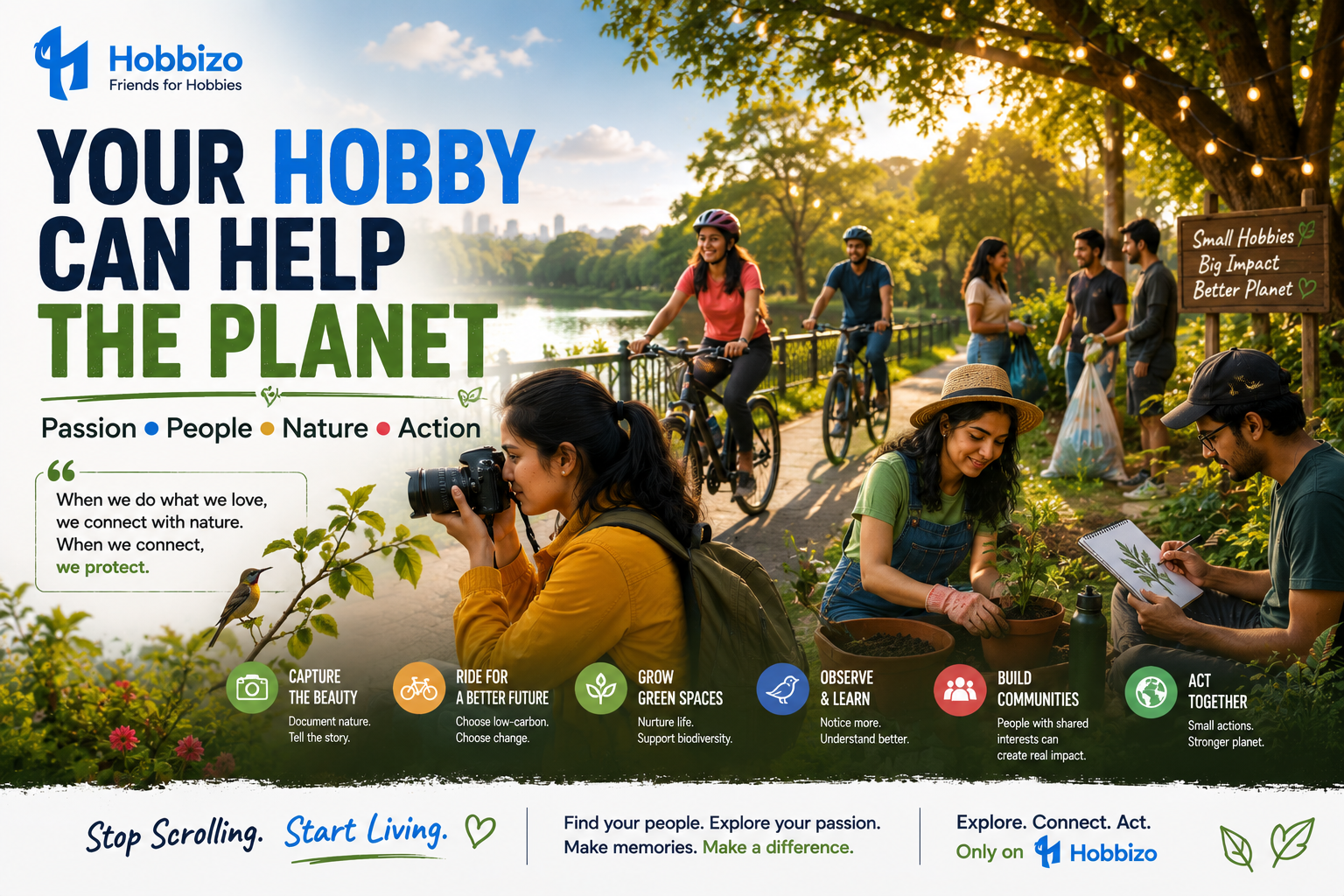
We usually think of hobbies as something we do for ourselves.
Photography because we love capturing moments.
Cycling because we enjoy being outdoors.
Gardening because watching something grow feels good.
Trekking because we want to explore.
Birdwatching because we are curious about the world around us.
But there is another side to hobbies that we don't talk about enough.
They can change the way we see the world around us.
And once you start noticing something, you are more likely to care about it.
That is where a simple hobby can become something bigger.
Not every hobby needs to “save the planet.”
But the right hobby can bring you closer to nature, introduce you to people who care about the same things, help document environmental changes, encourage responsible travel and sometimes even contribute useful information to conservation efforts.
Your passion can become your connection to the planet.
1. Photography: Don't Just Capture Nature. Notice It.
A photograph can freeze a moment.
But a collection of photographs can tell a story.
A photographer who regularly visits the same park, lake, forest or neighbourhood may begin noticing things that others miss:
- A bird that appears every season.
- A tree changing over time.
- A disappearing patch of green.
- A polluted water body.
- A new construction site.
- A landscape changing year after year.
Photography has already become part of conservation and citizen-science efforts in different places. Environmental observation programmes allow members of the public to record what they see and contribute to broader understanding of biodiversity.
The important part is responsible documentation.
- Don't disturb wildlife for the perfect shot.
- Don't enter restricted areas.
- Don't feed animals just to get a photograph.
Sometimes the most powerful environmental photograph is simply one that makes another person stop and look.
2. Birdwatching: Your Weekend Hobby Can Become Useful Data
You don't need to be a professional ornithologist to become interested in birds.
You can start with a balcony. A neighbourhood park. A college campus. A nearby lake.
Over time, birdwatching teaches something important:
nature is happening around us even when we are busy looking at our phones.
Citizen-science programmes use observations from volunteers to expand knowledge about biodiversity. NatureScot describes citizen science as a way for people of different ages and experience levels to contribute environmental information and develop their own understanding of nature.
That means your hobby can move beyond:
“Look what bird I saw today.”
to:
“I'm beginning to understand what lives around me.”
And that change in perspective matters.
3. Gardening: Creating Small Spaces for Living Things
You don't need a huge farm to interact with nature.
Even a balcony, terrace, courtyard or small community garden can become a place where plants, insects and people interact.
Growing plants can introduce people to:
- pollinators
- seasonal changes
- soil
- water
- native plants
- food systems
- biodiversity
And when gardening becomes a community activity, something else happens.
People start talking. Neighbours exchange plants. Students share growing tips. Families create small green spaces. Communities begin caring about the places they live in.
Recent examples of community gardening show how local green spaces can combine biodiversity, social interaction and neighbourhood participation.
A garden may look small.
Its community impact doesn't have to be.
4. Cycling: A Hobby That Can Change How You Experience a City
There is a major difference between seeing a city through a car window and experiencing it on a bicycle.
Cycling slows you down.
You notice streets. Trees. Parks. Local businesses. People. Traffic. Air quality. Places you would normally drive past.
And when cycling becomes a group hobby, it can create an entirely different relationship with the city.
Weekend cycling groups can combine:
fitness + exploration + friendship + lower-emission mobility.
WHO identifies walking and cycling as forms of active mobility that can provide health, social and environmental benefits, while also helping reduce traffic-related emissions when they replace motorised trips.
Of course, cycling should always be done in places and conditions that are safe.
But the larger idea is simple:
The way we move through a place changes how connected we feel to it.
5. Trekking: Explore Without Leaving a Footprint
Trekking gives people something that screens can't.
Perspective.
You see how large a forest actually is. How water moves through a mountain. How quickly weather can change. How dependent communities are on their surroundings.
But loving the outdoors also comes with responsibility.
A responsible trekker:
- carries waste back
- respects local rules
- stays on appropriate trails
- avoids disturbing wildlife
- respects local communities
- avoids damaging vegetation
- doesn't treat natural spaces as disposable backdrops
The goal isn't simply: “I visited the mountains.”
It is: “I visited the mountains without making them worse.”
6. Nature Journaling: Turn Attention Into Awareness
You don't need expensive equipment.
Take a notebook. Go outside. And observe.
- What birds did you see?
- Which flowers are blooming?
- Did the temperature feel different?
- Which insects appeared?
- Has the same tree changed?
- What happened after the rain?
This kind of regular observation can make environmental change feel less abstract.
Instead of hearing: “Biodiversity is changing.”
you begin noticing the biodiversity around you.
Instead of hearing: “Seasons are shifting.”
you start paying attention to seasonal patterns yourself.
That doesn't mean personal observation replaces scientific research. It doesn't.
But it can create something equally important at an individual level: environmental awareness.
7. Travel: Make the Journey Part of the Responsibility
Travel is one of the most common hobbies.
And it can also be one of the easiest places to make better choices.
Responsible travel can mean:
- Choosing local businesses.
- Respecting cultural practices.
- Avoiding unnecessary waste.
- Using shared or public transport where practical.
- Following local environmental rules.
- Not disturbing wildlife.
- Being careful about water use.
- Supporting communities rather than treating destinations simply as photo locations.
The best travel experience isn't necessarily the one where you leave the biggest digital footprint.
It may be the one where you leave the smallest physical footprint.
The Bigger Idea: Hobbies Create Communities
This is where the story becomes more interesting.
A hobby starts with an individual. Then someone finds another person who enjoys the same thing. Then another. Soon you have a group.
A cycling group. A photography walk. A trekking community. A gardening circle. A birdwatching group. A nature club.
And suddenly something that started as: “I enjoy this.”
becomes: “We care about this.”
That shift can be powerful.
ICIMOD has highlighted the importance of community-led action for biodiversity and environmental resilience, emphasising that meaningful conservation can be rooted in everyday local actions.
Your Hobby Doesn't Have to Save the Planet
This is important.
You don't need to turn every hobby into activism.
You don't need to feel guilty every time you travel.
You don't need to become an environmental expert overnight.
And you certainly don't need to believe that one person planting one plant will solve climate change.
That's not the point.
The point is connection.
When you spend more time outdoors, you notice nature.
When you notice nature, you understand it better.
When you understand something, you may care about protecting it.
And when people who care find each other, they can create communities.
That is where small actions become meaningful.
From Hobby to Real-World Action
Imagine this:
- A group of photographers meets for a weekend photo walk. They notice litter around a lake. The next weekend, they return with gloves and bags.
- A cycling group discovers a beautiful local green route. They begin documenting the condition of the area.
- A group of birdwatchers notices fewer birds in a familiar location. They start recording their observations through an appropriate citizen-science project.
- A group of trekkers learns about responsible tourism. They share that knowledge with other travellers.
None of these people started as environmental activists.
They simply started with something they loved.
The hobby opened the door.
Where Hobbizo Fits
Hobbizo isn't an environmental organisation.
And it doesn't need to be.
Its role is much simpler:
People with shared interests find each other.
A photography enthusiast can meet other photographers.
A cyclist can discover other riders.
A trekking lover can find people who want to explore.
A nature enthusiast can connect with people who care about the same spaces.
And sometimes, those connections can turn into something beyond the hobby itself.
A weekend activity. A local clean-up. A responsible travel group. A nature walk. A community initiative. A shared experience.
Because sometimes the first step toward caring about a place is simply finding people who enjoy being there too.
The Planet Doesn't Need Everyone to Be an Activist
It needs people to pay attention. To notice. To learn. To participate. To respect the places they visit. To share accurate information. And, whenever possible, to act together.
Your hobby may not change the world overnight.
But it can change your relationship with the world around you.
And that can be the beginning of something bigger.
Find something you love. Find people who love it too.
And see where that connection takes you.
Stop Scrolling. Start Living.
Frequently Asked Questions
1. Can a hobby really help the environment?
Yes, indirectly and sometimes directly. Hobbies can increase people's connection with nature, encourage responsible behaviour, support citizen-science observations and bring communities together around local environmental activities.
2. Which hobbies are good for the environment?
Photography, birdwatching, gardening, trekking, cycling, nature journaling and responsible travel can all create opportunities for environmental awareness and community action.
3. Can photography contribute to conservation?
Yes. Photography can document biodiversity and environmental changes, and photographs can also be part of citizen-science projects when collected and submitted through appropriate programmes.
4. Is cycling an environmentally friendly hobby?
Cycling generally has a low environmental impact compared with motorised travel, particularly when it replaces short car or motorbike trips. WHO recognises cycling and walking as active mobility options with health and environmental benefits.
5. What is citizen science?
Citizen science involves members of the public participating in activities that collect or contribute information for scientific or environmental research. Participants can have different levels of experience.
6. Can students participate in environmental activities?
Absolutely. Students can participate in nature observations, photography projects, clean-ups, gardening, biodiversity activities and responsible outdoor communities.
7. How can trekking become more responsible?
Follow local rules, avoid disturbing wildlife, minimise waste, stay on appropriate routes and respect local communities and ecosystems.
8. Can hobbies help people build environmental communities?
Yes. Shared interests naturally create opportunities for people to meet, learn and organise activities together. Community-led environmental action can play an important role in conservation.
Why Hobbies Are Important for a Healthy Life
Reduce Stress Naturally
Improve Mental Health
Stay Active & Fit
Sleep Better at Night
Build Real Friendships
Learn New Skills
Ready to find your hobby tribe?
Discover nearby people, communities and events on Hobbizo.
Download AppWhat You Can Do with Hobbizo
Find Nearby People
Join Communities
Discover Events
Chat & Network
Showcase Talent
Help Save Lives
Popular Articles



Categories
Newsletter
Never miss a new hobby story. Get the latest blogs and event inspiration.
Join the Conversation
0 CommentsWant to join the discussion?
Log in with Google to share your thoughts and reply to comments.