Some Things Never Get Old: The Hobbies We Carry Through Life

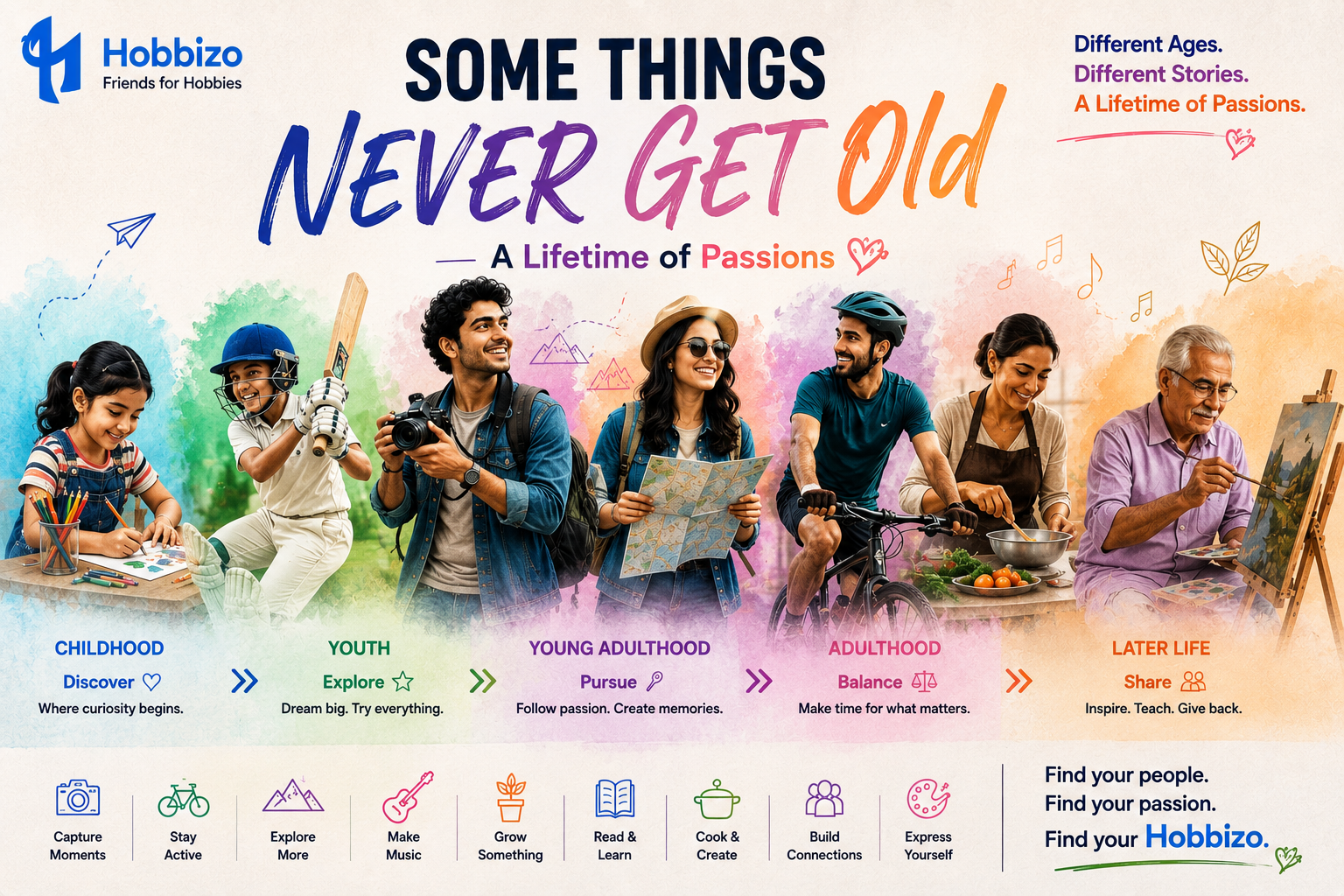
The hobby may change. The people may change. The reason may change. But the joy of doing something you love can stay with you for a lifetime.
At 10, You Play. At 30, You Make Time. At 60, You Share It.
Think about something you loved doing when you were younger.
- Maybe it was cricket in the street.
- Drawing in the last pages of your notebook.
- Cycling around your neighbourhood.
- Dancing whenever your favourite song played.
- Building things.
- Collecting things.
- Playing an instrument.
- Going somewhere just because you wanted to see what was there.
Nobody called these things a “hobby” back then. You simply enjoyed them.
Then life happened. School became college. College became work. Responsibilities increased. Time became harder to find.
And somewhere along the way, many of us stopped doing the things that once made us forget to check the clock.
But here's the thing: Growing older doesn't mean growing out of the things you love.
Sometimes, your hobbies simply grow with you.
The Hobby Changes. The Feeling Doesn't.
A hobby isn't necessarily something you do in exactly the same way for your entire life. It can evolve.
- A child who loves drawing might eventually discover graphic design.
- Someone who plays cricket in school might later join a weekend cricket group.
- A teenager who takes random photographs might eventually discover travel photography.
- Someone who loves plants might eventually create a garden.
The activity may become more sophisticated. Your reasons may change. Your circumstances may change.
But the underlying feeling can remain remarkably similar: Curiosity. Creativity. Freedom. Joy.
That's what makes hobbies different from many of the things we have to do. You don't do them because someone told you to. You do them because something inside you wants to.
Childhood Hobbies Don't Really Disappear
Remember the things you used to love? The drawing you couldn't stop making. The bicycle you rode everywhere. The cricket bat that somehow became your most important possession. The music you kept replaying. The games you played with friends until someone called you home.
As children, we rarely worry about whether an activity is productive enough. We simply enjoy it.
Then adulthood teaches us to measure almost everything: Is it useful? Will it help my career? How much money can it make? Do I have time for it?
And hobbies slowly move to the bottom of the list. Maybe that's one reason returning to an old hobby can feel so different. For a moment, you're not trying to achieve anything. You're just enjoying something again.
At Every Age, Hobbies Can Look Different
- 🧒 Childhood (Discovery): “What can I do?” — Drawing, playing, building, exploring, collecting, singing, dancing.
- 🧑 Teenage & College Years (Identity): “Who am I?” — Music, sports, photography, gaming, travel, dance, fitness, writing.
- 👨💼 Adulthood (Protection): “What makes me feel like myself?” — Weekend cycling, cooking, reading, gardening, photography, travel, running, music.
- 👴 Later Life (Enjoyment & Connection): “What do I still want to experience?” — Gardening, walking, music, photography, painting, birdwatching, travel, chess, volunteering, learning something completely new.
There isn't a correct age for any of these. There is only the age at which you discover them.
You Don't Have to Be Good at Your Hobby
This might be one of the most important things we've forgotten.
You don't need to be a professional photographer to take photographs.
You don't need to become a musician to play music.
You don't need to win tournaments to enjoy a sport.
You don't need to become an artist to paint.
You don't need thousands of followers to create something.
A hobby doesn't need an audience. It needs your attention.
And perhaps that's what makes hobbies so valuable in a world where almost everything we do online seems to be measured by likes, views, followers and achievements. Some things are allowed to exist simply because you enjoy them.
Travel Is a Hobby That Changes With You
Travel is perhaps one of the clearest examples.
At 18, a trip might be about adventure. At 25, it might be about discovering a new place with friends. At 35, it might be about taking your family somewhere special. Later in life, it might be about finally visiting a place you've dreamed about for decades.
The destination changes. The pace changes. The people travelling with you may change. But the curiosity remains.
And sometimes travel becomes more meaningful because you experience the same world through different generations — a parent showing a child a place they once loved, or a grandparent sharing stories from an old journey.
Some Hobbies Become Family Stories
Think about the hobbies that have been passed through your family: a father teaching his child to ride a bicycle, a grandmother teaching a recipe, a grandfather teaching chess.
And today, the direction can be completely reversed:
- A young person can teach a parent how to use a camera.
- A teenager can introduce a grandparent to a new kind of music.
- A child can convince an entire family to start gardening.
That's something beautiful about hobbies: They don't only pass from old to young. Sometimes, they travel in the opposite direction.
The Best Part? Hobbies Can Cross Generations
Age can divide people in many situations: different schools, different careers, different lifestyles, different generations.
But put two people together who love the same thing, and suddenly there's a conversation.
A 20-year-old photographer and a 60-year-old photographer may have completely different life stories. But put a camera in front of them and they already have something to discuss. Shared interests can make differences feel smaller. That's one reason hobbies can become powerful social connectors.
2026: Why Are We Looking for Real Hobbies Again?
We're living through an extremely digital period. We work online, study online, talk online, watch entertainment online, shop online, and spend a surprising amount of our free time scrolling.
At the same time, 2026 trend reporting continues to highlight renewed interest in hands-on, offline and “analog” activities such as crafting, journaling, gardening and other activities that involve making or doing something in the physical world.
Maybe that's not a coincidence. After spending so much time consuming things through screens, people may simply want experiences that feel tangible again — something they can touch, make, learn, explore, and share in the real world.
Maybe We Don't Need More Content. Maybe We Need More Experiences.
We can watch someone else travel, or we can travel.
We can watch someone play guitar, or we can learn three chords ourselves.
We can watch cycling videos, or we can take the bicycle outside.
We can watch photography reels, or we can walk around our neighbourhood and find something worth photographing.
The difference is simple. One gives us content. The other gives us a memory. And memories are often created when we're actually doing something.
A Hobby Can Give You More Than a Hobby
It can give you a reason to go outside, a reason to learn, a reason to create, a reason to meet someone, a reason to travel, a reason to put the phone down, and sometimes, a reason to feel like yourself again.
Research on healthy ageing also recognises the value of continuing activities people enjoy and participating in social and community activities as people grow older.
You Might Not Have Lost Your Hobby. You Might Have Lost the Time for It.
There's a difference.
- Maybe you still love music. You just haven't played in years.
- Maybe you still love photography. You just stopped carrying a camera.
- Maybe you still love cricket. You just don't have a group to play with.
- Maybe you still want to travel. You just keep waiting for the “right time.”
- Maybe you still love painting. You just haven't opened that old box of colours.
The hobby might still be there. Waiting for you.
And Starting Something New Doesn't Have an Age Limit
You don't need childhood memories to justify a hobby. You can start today—at 16, 26, 36, 46, 66, or even at 86.
You can pick up a guitar for the first time, join a photography walk, start gardening, learn to cook, try pottery, take up cycling, start birdwatching, learn a new language, or travel somewhere you've never been.
Being new at something isn't embarrassing. It means you're still curious.
Hobbies Don't Ask How Old You Are
A hobby doesn't care about your age. It doesn't care about your job title. It doesn't care about your follower count. It doesn't care whether you're a beginner or an expert. It simply gives you something to enjoy.
And when you find other people who enjoy the same thing, something else can happen: a conversation, a friendship, a group, a trip, a memory, a community.
Where Hobbizo Fits
Hobbizo believes in something simple: People connect naturally when they have something they genuinely enjoy in common—whether it's music, photography, travel, sports, fitness, art, food, gaming, or nature.
The age doesn't have to match. The background doesn't have to match. The personality doesn't have to match. Sometimes, all you need is one shared interest.
Because the best connections don't always begin with: “Tell me about yourself.”
Sometimes they begin with: “Wait… you like this too?”
The Things We Love Can Become the Stories We Tell
Years from now, you may not remember every deadline, every notification, every meeting, or every ordinary Tuesday. But you might remember that trip with your friends, that first photograph you were proud of, the cricket match that went on until sunset, or the stranger who became a friend because you shared the same hobby.
Those are the moments that become stories.
Some Things Never Get Old
Maybe growing older isn't about leaving our younger selves behind. Maybe it's about carrying the best parts of that person forward — the curiosity, the excitement, the willingness to try, the joy of making something, the urge to explore, the desire to connect.
Your life will change. Your priorities will change. Your hobbies may change too. And that's okay. Because a hobby doesn't have to stay the same to remain meaningful.
The hobby changes. The way we experience it changes. But the feeling can stay.
So pick up the camera again. Join the game. Plant something. Learn the song. Take the trip. Start the hobby you've always wanted to try. Find people who enjoy it too.
Because you never really outgrow the things that make you feel alive. You just discover new ways to love them.
Some things never get old. They simply grow with you.
Stop Scrolling. Start Living.
Frequently Asked Questions
1. Can hobbies really stay important as we grow older?
Yes. Hobbies can provide opportunities for enjoyment, learning, creativity and social participation throughout different stages of life. The type and intensity of an activity may change, but the interest itself can continue.
2. Is it too late to start a new hobby?
No. There is no universal age limit for learning an activity. New hobbies can be started at virtually any stage of life.
3. Can hobbies connect different generations?
Yes. Shared interests can create natural opportunities for people of different ages to spend time together, learn from each other and share experiences.
4. Why are offline hobbies becoming popular again?
Recent 2026 trend coverage points toward renewed interest in hands-on and analog activities, including crafts, journaling and gardening, alongside growing interest in experiences that take place away from screens.
5. Does a hobby have to be productive?
No. A hobby can simply be something you enjoy. It doesn't need to generate income, improve your career or produce something measurable.
6. Can travel be considered a hobby?
Yes. For many people, exploring new places, cultures, landscapes and experiences becomes a long-term interest that evolves throughout life.
7. What if I don't have much time for hobbies?
You don't necessarily need several hours. A hobby can begin with a small amount of regular time — a short walk, a few pages of reading, a quick photo walk or a weekend activity.
8. Can hobbies help people make friends?
They can create natural opportunities to meet people who already share an interest. Shared activities give people an easy starting point for conversation and participation.
Why Hobbies Are Important for a Healthy Life
Reduce Stress Naturally
Improve Mental Health
Stay Active & Fit
Sleep Better at Night
Build Real Friendships
Learn New Skills
Ready to find your hobby tribe?
Discover nearby people, communities and events on Hobbizo.
Download AppWhat You Can Do with Hobbizo
Find Nearby People
Join Communities
Discover Events
Chat & Network
Showcase Talent
Help Save Lives
Popular Articles



Categories
Newsletter
Never miss a new hobby story. Get the latest blogs and event inspiration.
Join the Conversation
0 CommentsWant to join the discussion?
Log in with Google to share your thoughts and reply to comments.