Everyone Talks About the Flood. But What Is Happening to the Himalayas?

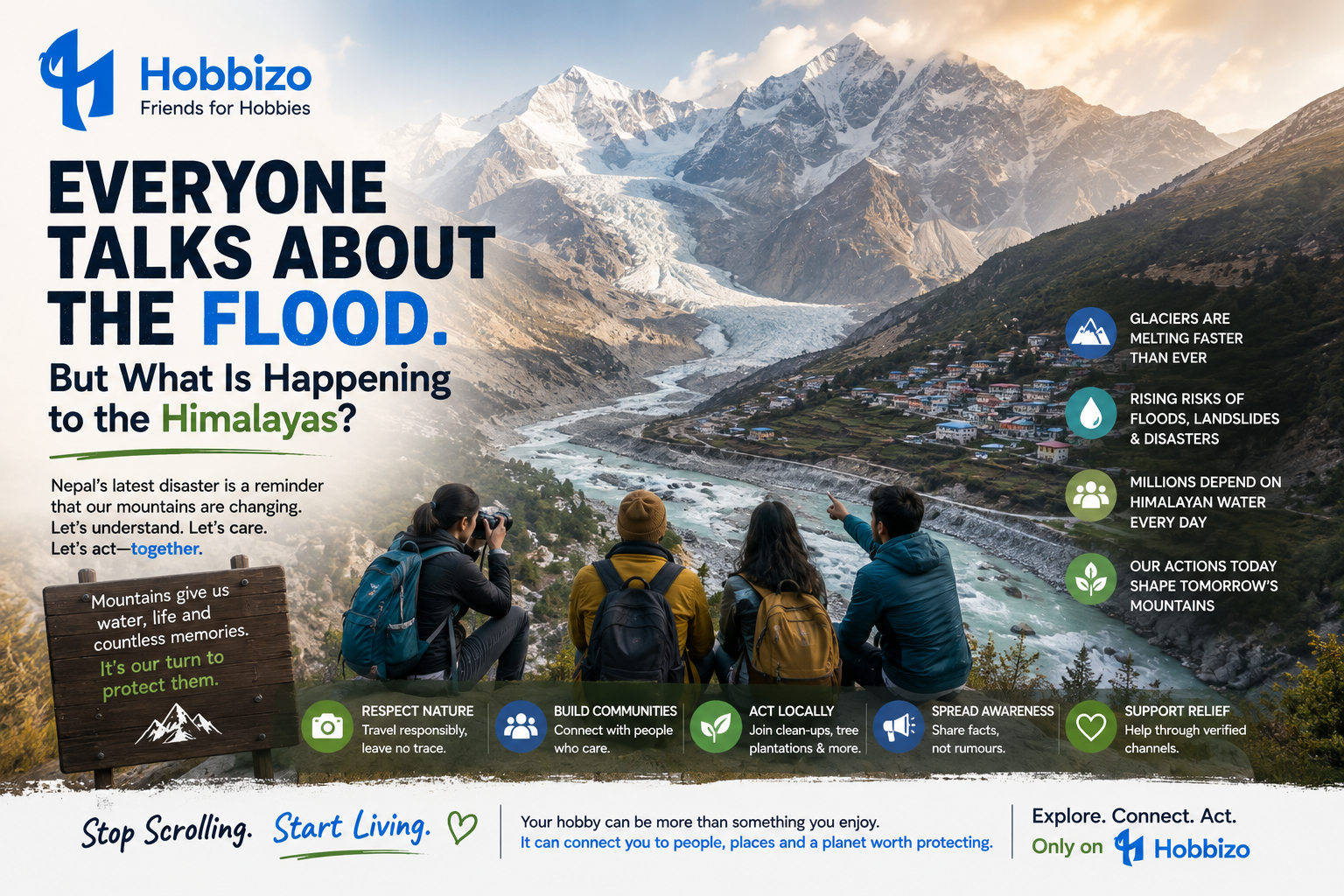
The Himalayas are easy to see as a landscape.
Snow-covered peaks. Glaciers. Rivers cutting through deep valleys. Trekking trails leading into some of the highest mountains on Earth.
But the Himalayas are much more than scenery.
They are ecosystems, water sources, homes, livelihoods, tourism destinations and cultural landscapes.
What happens high in the mountains can eventually affect people hundreds of kilometres away.
This week, that connection became impossible to ignore.
A major flash flood struck the Nepal–China border region after an ice-and-rock collapse sent huge amounts of debris into a river system, creating a powerful downstream flood. Communities, infrastructure and travel routes were affected, while rescue teams began searching for people still unaccounted for.
But there is a bigger environmental story behind the disaster.
The question is not only:
“What caused this flood?”
It is also:
“What is happening to the Himalayan environment?”
What Happened in Nepal?
On August 26, 2026, a major flash-flood event struck the Himalayan border region between Nepal and China’s Tibet.
According to Reuters, a large mass of glacial ice and rock collapsed and entered the Lhende Khola river system, producing a powerful flow of water, mud and debris downstream. Roads, bridges and other infrastructure were damaged, while rescue and relief operations continued.
The initial explanation of the event also changed as more information became available.
A seismic signal was initially interpreted as a possible earthquake. Reuters later reported that the U.S. Geological Survey determined that the signal was generated by the collapse and debris movement rather than an earthquake.
The exact chain of physical events is still being investigated.
That distinction matters. In a developing disaster, early explanations can change as satellite imagery, field observations and scientific analysis become available.
As of August 27, 2026, casualty and missing-person figures were still developing. Reuters reported at least 165 deaths and nearly 1,500 people missing across Nepal and Tibet, while AP reported at least 168 deaths and more than 1,300 missing in its latest update. The difference reflects the rapidly changing situation and ongoing rescue and identification efforts.
How Can a Mountain Collapse Become a Flash Flood?
A mountain disaster does not always happen through one simple process. Several natural processes can interact.
A simplified chain can look like this:
Ice and rock become unstable
↓
A large collapse or avalanche occurs
↓
Ice, rock and sediment enter a river or valley
↓
Water and debris are suddenly displaced
↓
A powerful surge moves downstream
↓
Communities and infrastructure can be overwhelmed
In the Nepal event, experts have linked the flooding to an ice-and-rock avalanche and the resulting debris movement.
But the precise mechanism and contributing factors are still being studied.
This is why mountain hazards are often described as cascading or compound hazards. One event can trigger another. A collapse can create a debris flow. A debris flow can enter a river. A river surge can become a flash flood. And a flood can travel far beyond the location where the original collapse occurred.
The Bigger Story: A Changing Himalayan Environment
The Nepal disaster is part of a much larger environmental conversation. Across the Hindu Kush Himalaya, glaciers are losing ice.
ICIMOD’s 2026 glacier assessment reports that glacier ice-loss rates have doubled since 2000. Its research also estimates that glaciers across the region have lost up to 27 metres of ice thickness since 1975.
The organisation describes the Hindu Kush Himalaya as one of Asia’s most important sources of water, with its cryosphere supporting hundreds of millions of people in mountain areas and more than two billion people downstream.
This does not mean that every glacier retreat immediately produces a disaster. It means the physical environment in which mountain communities live is changing.
- Glacier loss.
- Changing snow patterns.
- Permafrost degradation.
- Changing river behaviour.
- Glacial lakes.
- Landslides and debris flows.
These processes can interact in complex ways.
ICIMOD’s latest regional strategy notes that changes in glaciers, snow and permafrost are increasing uncertainty around water systems and intensifying risks from hazards such as glacial lake outburst floods, avalanches, debris flows and landslides.
Climate Change: What We Know — And What We Don't
This is where environmental reporting needs to be careful. It would be wrong to simply write:
“Climate change caused the Nepal flood.”
The science does not support such a simple statement for this individual event. The immediate trigger of this disaster needs to be established through event-specific investigation.
However, there is strong scientific evidence that climate change is altering the broader Himalayan environment.
The region is warming. Glaciers are losing mass. Snow patterns are changing. Permafrost is degrading. And these changes can affect the stability of high-mountain environments.
Reuters reported that scientists studying the Nepal event believe warming can contribute to conditions that make mountain ice and rock more unstable, while also cautioning against treating climate change as the sole immediate cause of the disaster.
So two statements can be true at the same time: Climate change is changing Himalayan conditions. And we still need scientific evidence before saying it directly caused one particular collapse.
That distinction is not a technicality. It is what responsible climate communication looks like.
Why Glacier Loss Matters
Glaciers are not simply frozen landscapes. They are part of a much larger water system.
The Hindu Kush Himalaya feeds major river basins that support communities, agriculture, ecosystems and economies across Asia.
ICIMOD estimates that the region contains more than 63,700 glaciers and that its ice and snow systems contribute to major Asian river systems.
When glaciers lose mass, the consequences are not limited to the mountain slopes.
- Changes in meltwater can influence seasonal water availability.
- Changing snow and ice can affect ecosystems.
- Retreating glaciers can reshape terrain.
- And changing mountain conditions can alter the risks faced by communities and infrastructure.
This is why glacier monitoring matters. Scientists need long-term observations to understand not just what is happening today, but how mountain systems are changing over decades.
Why This Matters to India and South Asia
The Himalayas do not follow national borders. Water does not either.
The rivers connected to the Hindu Kush Himalaya support huge populations across South Asia. That makes Himalayan environmental change relevant to India even when a disaster occurs in Nepal or Tibet.
It matters for:
- Water security
- Agriculture
- Hydropower
- Tourism
- Trekking and pilgrimage
- Mountain livelihoods
- Roads and bridges
- Downstream communities
- Disaster preparedness
The point is not that every Himalayan change will create a disaster. The point is that millions of people are connected to these mountain systems. When the mountains change, the effects can travel.
The Human Side of a Mountain Disaster
Satellite images can show rivers changing course. They can show damaged roads. They can show debris covering infrastructure.
But behind every image are people.
Mountain communities live and work in these landscapes. Tourism workers depend on visitors. Farmers depend on water. Engineers build infrastructure through difficult terrain. Trekking and pilgrimage routes connect people with places that have enormous cultural and economic importance.
And when a disaster occurs, rescue teams have to work in some of the most difficult terrain on Earth.
The current Nepal disaster has already shown how quickly infrastructure can become a barrier to rescue and communication. Reuters reported that damaged roads and bridges have complicated rescue operations, while authorities have continued searching for missing people across affected areas.
Environmental awareness therefore cannot be separated from disaster preparedness. Understanding the environment is ultimately about protecting people.
What Can Young People Actually Do?
You do not need to be a climate scientist to contribute. You can start much closer to home.
Travel Responsibly
If you trek, camp or travel in mountain regions, follow local guidelines and respect fragile ecosystems.
Reduce Waste Outdoors
Carry your waste back with you. Avoid unnecessary single-use plastic. Leave natural spaces as you found them.
Learn Before You Explore
Check weather conditions, route advisories and local safety guidance before heading into mountain areas.
Join Local Environmental Activities
Participate in clean-up drives, tree-planting programmes, biodiversity initiatives and local conservation projects.
Learn Basic Disaster Preparedness
Understanding what to do during floods, landslides and other emergencies can make a real difference.
Stop Sharing Unverified Information
During disasters, misinformation spreads quickly. Before forwarding a casualty figure, dramatic video or rescue claim, check the source.
Support Verified Relief Efforts
If you want to help after a disaster, use established humanitarian organisations or official government channels.
Document Nature Responsibly
Photography, filmmaking and travel content can help people understand environmental change. But vulnerable communities should never become entertainment.
When Hobbies Become a Force for Good
A hobby can begin as something personal. Trekking. Photography. Cycling. Travel. Birdwatching. Nature walks. Camping.
But hobbies can also create communities.
- A trekking group can learn about mountain ecosystems.
- Photographers can document changing landscapes.
- Cyclists can organise local clean-up activities.
- Travellers can promote responsible tourism.
- Students can create environmental-awareness initiatives.
And people who simply love nature can find others who feel the same way.
That is where hobbies can become something bigger. People with shared interests can learn together. Communities can care together. And communities can act together.
This is also where Hobbizo naturally fits into the bigger picture — not as a solution to environmental problems, but as a reminder that real-world interests can bring people together around causes, places and experiences they genuinely care about.
A hobby can be more than something you do alone. Sometimes, it can be the beginning of a community.
The Himalayas Are Not Just a Background
The latest flood in Nepal should not be reduced to a headline. It should not become a dramatic social-media image. And it should not be used to make simplistic claims about climate change.
It is a human tragedy. But it is also an opportunity to understand a changing environment.
The evidence shows that Himalayan glaciers are losing ice. Snow and permafrost conditions are changing. Mountain hazards can interact with one another. And communities across South Asia remain deeply connected to these systems.
The answer is not fear. It is awareness.
- Better monitoring.
- Better early-warning systems.
- Better infrastructure planning.
- Better disaster preparedness.
- Better climate adaptation.
- And communities that understand the environments they live, travel and grow up around.
The Himalayas are not just a landscape in the distance. They are part of the systems that sustain people. And when those systems change, all of us have a reason to pay attention.
Stop Scrolling. Start Living.
But perhaps, when it comes to the environment, there is another message worth remembering:
Stop scrolling past the world. Start paying attention to it.
Frequently Asked Questions (FAQs)
What happened in Nepal on August 26, 2026?
A major flash-flood event occurred near the Nepal–China border after an ice-and-rock collapse sent debris into the Lhende Khola river system. The resulting flood damaged communities and infrastructure and triggered large-scale rescue operations.
Did an earthquake cause the Nepal flood?
No earthquake has been established as the cause. Reuters reported that the U.S. Geological Survey determined that the seismic signal initially interpreted as an earthquake was generated by the collapse and debris movement.
Did climate change cause this specific flood?
It is too early to make that claim definitively. Scientists are investigating the exact chain of events. Climate change is, however, changing Himalayan glaciers, snow, permafrost and other mountain conditions that can influence hazard risks.
Are Himalayan glaciers shrinking?
Yes. ICIMOD’s 2026 assessment reports that glacier ice-loss rates across the Hindu Kush Himalaya have doubled since 2000.
Why are Himalayan glaciers important to India?
The Hindu Kush Himalaya contributes to major Asian river systems that support water supplies, agriculture, ecosystems, energy and livelihoods across the region.
What are cascading mountain hazards?
Cascading hazards occur when one physical event triggers or contributes to another. For example, an ice-rock collapse can produce a debris flow, which can enter a river and generate downstream flooding.
What can young people do to help the environment?
Young people can participate in local environmental activities, practise responsible tourism, reduce waste, learn disaster preparedness, share verified information and support credible conservation or relief initiatives.
Can hobbies help environmental awareness?
Yes. Hobbies such as trekking, photography, cycling, nature walks and travel can create communities that learn about and participate in environmental activities.
Why should people outside Nepal care about Himalayan environmental change?
Because the Himalayas are connected to major water systems, ecosystems, economies and communities across South Asia. Environmental changes in the mountains can have consequences far beyond the immediate location.
How can I learn more about Himalayan environmental change?
Follow research and monitoring organisations such as ICIMOD, NASA and other established scientific institutions rather than relying on unverified social-media claims.
Why Hobbies Are Important for a Healthy Life
Reduce Stress Naturally
Improve Mental Health
Stay Active & Fit
Sleep Better at Night
Build Real Friendships
Learn New Skills
Ready to find your hobby tribe?
Discover nearby people, communities and events on Hobbizo.
Download AppWhat You Can Do with Hobbizo
Find Nearby People
Join Communities
Discover Events
Chat & Network
Showcase Talent
Help Save Lives
Popular Articles



Categories
Newsletter
Never miss a new hobby story. Get the latest blogs and event inspiration.
Join the Conversation
0 CommentsWant to join the discussion?
Log in with Google to share your thoughts and reply to comments.